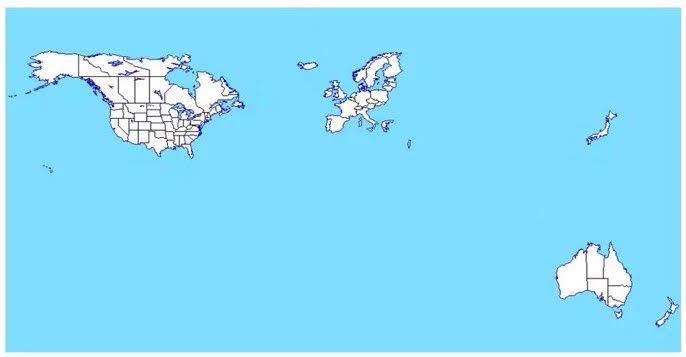
Map of the international community. Source: Terrible Maps
Have a look at this map. Is there anything missing from it? If you were Martin Wolf, the Chief Economics Commentator of the Financial Times, you would probably think that this is a map of “the world”—all of it. This is hardly a sarcastic remark, and I will prove it to you in this post.
Martin Wolf is hosting a six-part series of interviews on the upcoming mid-term elections in the United States on November 3rd, 2026. Two episodes have been broadcast so far (as of Friday, October 30). Both episodes start with an intro in which Wolf expresses his concern for “the future of democracy” and whether “the United States will continue to be the leader of the free world” after the elections. He is concerned that a Republican victory—or Trump intervening to hinder a Democratic win—could usher in an era of authoritarianism in the US and beyond. Toward the end of the intro, Wolf adds a grim warning: the history of his parents—both Jewish refugees who fled to London from the Nazis—has taught him “what happens when democracy fails“.

Martin Wolf, 2015. Source: Wikimedia
It is obvious from the intro that Wolf holds the uncritical belief that democracies are morally good, or, to be more precise, democracies do not commit evil acts such as genocide, as can be inferred from his implicit reference to the Holocaust. It’s not clear whether he also thinks that the American wars on Vietnam and Iraq, French and British colonialism, and the Israeli occupation and ethnic cleansing of Palestine—all committed by so-called democracies—have been failures of democracy too. In that case, democracy would be a system that fails a lot, almost all of the time, so what is the point of saving it?
But I’m not concerned here with a debate about the morality of democracies, within or outside their national boundaries. As I stated in the first paragraph, I want to show you what—almost literally—counts as “the world” for Martin Wolf. He reveals that in the second episode, when he says that he wants to discuss with his guest, journalist Anne Applebaum, what these elections:
… will or could tell us about the health of American democracy and also, even more so, what they might mean for the rest of the world, which is slowly and painfully adjusting to the idea that the United States may no longer be a dependable ally.
(at around 2:00 in the YouTube version of the podcast)
Obviously, at no point in history was the US a “dependable ally” to every single country, or to most countries in the world, which leaves us no choice but to conclude that “the world” for Martin Wolf consists of the US and its allies only.
The title of this episode confirms this conclusion in no uncertain terms: “Can the world still trust America?” Again, at what moment in history has “the world” [sic] trusted the US? Have the Vietnamese people who were burned by American napalm ever trusted the US? Have the Iranians who saw their democratically elected government overthrown by an Anglo-American coup for oil? Have the Cubans who are being strangled by draconian American sanctions? Have the Arabs who see Israel mass-murdering Palestinian and Lebanese civilians using American-made weapons? Have the many Latin American nations whose popular socialist governments were replaced by US-backed military dictatorships? Have the sub-Saharan Africans whose gold and diamonds are being plundered by Western companies? Apparently, those people are not part of “the world”.
“The world” according to Martin Wolf is made clear in his use of the phrase “the leader of the free world” in the intro, which is an old cliché of pro-American propaganda during the Cold War that has been rehashed in the aftermath of the Russian invasion of Ukraine. The “free world” is basically Western Europe and its Anglo-Saxon settler-colonial extensions: the United States, Canada, Australia, and New Zealand, along with a few countries in East Asia—most importantly Japan and South Korea—that are practically under the protection of the United States (American “semi-protectorates”, if you will).
The “free world” would also include some post-communist countries in Eastern Europe that have been or are to be integrated into the EU-NATO complex1 (not all of them are represented in the map, though). But much like countries in the Mediterranean region that joined this privileged club in the 1980s—such as Spain, Portugal, and Greece—they are more satellites than core members. The “VIP members” of this club remain a handful of heavily industrialized and militarized countries on both sides of the North Atlantic—namely, the US, the UK, France, and (West) Germany.
The label used to refer to this group of countries may change from time to time or from person to person along with its exact boundaries. Sometimes they are called the white race, (Western) Christian civilization (before exterminating 6 million Jews), Judeo-Christian civilization (after exterminating 6 million Jews), the West, the North Atlantic, the Global North, etc. The labels have changed but the above core members have not for, more or less, three centuries.
If “the world” according to Martin Wolf is to be spelled out on a map, I think that the map at the beginning of this post would depict it fairly accurately. The map is taken from a satirical Instagram page called “Terrible Maps“, which posted it with the caption “a map showing ‘the international community’“. It perfectly captures the hypocrisy of the United States and its allies when they speak of “the international community”. It is as if other countries, which may comprise the vast majority of the world, didn’t exist.
The question now is: what does Martin Wolf think about countries that are not part of “the world”? In previous eras, Western ideologues would have called them “barbarians” and “savages”, but most contemporary Western-liberal pundits have learned to avoid such overtly racist vocabulary. Their departure from racism, however, doesn’t go far beyond language in my view.
Some people may call Martin Wolf’s worldview Eurocentrist—focusing on Western Europe and its allies or privileging them over others—to distinguish it from blatant Western/white supremacy. But I don’t think that the gap between the two sides is as wide as many may think. His Euro-supremacism appears in what he omits, not in what he utters. If one side of the West calls the rest of the world barbarians that can be invaded, subjugated, and exploited, the other side doesn’t seem to think they exist, especially when it speaks of its lofty ideals of democracy and human rights. So, if they are invaded, subjugated, and exploited, it wouldn’t seem terrible at all.
I’m sure that if Wolf were asked what “the world” consists of for him, he would include all countries in Asia, Africa, and Latin America, but this wouldn’t prove his universalism. A universalist wouldn’t need to be reminded that there’re countries in the world other than those that matter to him.

Anne Applebaum. Source: Wikimedia
If Martin Wolf could be given the benefit of the doubt, his guest, Anne Applebaum, does not deserve it in the slightest. She is a foreign-policy hawk who cheered the American invasion of Iraq in 2003 and openly called for the murder of Palestinian journalists in 2002 in a piece published in Slate under the hideous title “Kill the Messenger“. In 2024, she blamed the publisher for the “provocative title”, denying she had ever legitimated the targeting of journalists, even though this was exactly what she said:
Establishing a credible media will be, for the Palestinians, part of what it takes to establish a credible state. Until then, the Voice of Palestine will remain what it has become: a combatant—and therefore a legitimate target—in a painful, never-ending, low-intensity war. [emphasis added]
The map of the “international community” perfectly captures “the world” according to Martin Wolf, Anne Applebaum, and other liberal Western apologists. The countries on that map are inhabited by civilized nations, whose democracy and human rights are to be protected from right-wing populist authoritarianism. The rest is inhabited by less important, invisible nations. At best, they are to be ignored and forgotten. But they may also be invaded, occupied, ethnically cleansed, and colonized by settlers. They exist only when unfriendly governments are to be overthrown, when capitalism is to find new markets, when cheap labor is to be exploited, and when raw materials are to be plundered. But when we talk of saving democracy, the world shrinks to the countries shown in the map above.
- Apart from four relatively small countries—Cyprus, Malta, Ireland, and Austria—the EU is basically a subgroup of NATO. The so-called “Indo-Pacific Four” (or IP4)—Japan, South Korea, Australia, and New Zealand—are close partners of NATO, even though they are not members. ↩︎

