For millennia, human beings have been making all kinds of arguments for the existence of God, deities, or any spiritual being/reality beyond the material world. One of the most unusual of these arguments is the one made by French mathematician and philosopher Blaise Pascal (1623-1662), which came to be known as Pascal’s Wager. It is not based on a logical, epistemological, scriptural, or experiential evidence but on probability: if you believe in God and live accordingly, and it turns out to be true, you win infinite rewards. If it turns out to be false, you lose relatively little—some restrictions on your daily life, but you can still live a happy fulfilling life. If you don’t believe, and it turns out that there is God, you risk losing too much, e.g. eternal damnation in Hell!
1. Pascal’s Wager:

Blaise Pascal. Source: Wikimedia
The wager appeared in Pascal’s Pensées (published posthumously in 1670), which consists of fragments that he intended to publish as a book providing an apology of Christian belief. Pascal argues that a philosophical proof of God’s existence is impossible because there’s no absurdity arising from not believing in him: nature is perfectly explainable without God. Using probability and an early form of decision theory, however, he shows that the expected value of belief in a (Christian) God is way greater than that of unbelief, hence it’s rationalto wager (bet) on his existence (Cambridge Dictionary of Philosophy, “Pascal, Blaise” p. 649-50).
| Outcome → | God exists | God doesn’t exist |
| Wager for God (believe) | r1 | r2 |
| Wager against God (disbelieve) | r3 | r4 |
A rewards table based on Pascal’s wager
Suppose that p is the probability that God exists, then 1-p is the probability that he doesn’t exist. (0<p<1)
If r1 through r4 are the supposed rewards, then r1=∞, r2 and r4 are finite, r3 could be finite or -∞
Expected value for the wager for God (believe) is E1 = ∞*p + r2*(1-p)= ∞, whereas the expected value for wager against God (disbelieve) is E2 = r3*p + r4*(1-p) = finite or -∞. Since E1 > E2, it’s more rational, according to Pascal, to bet that God exists.
According to Pascal, the bet is not a choice but obligatory because humans are imbued with an “existential imperative” toward certainty, hence they cannot suspend their judgment indefinitely. In the words of Pascal, “you must take on the bet, for you are in the game“ (The Routledge Encyclopaedia of Philosophy, “Pascal, Blaise”).
It should be noted that for Pascal the wager is not the end of the journey of acquiring belief but its starting point. He recommends that individuals “embark on a course of praxis, such as regularly going to church, which ‘in the natural course of events will make you believe’.” (The Oxford Companion to Philosophy, “Pascal, Blaise”, p. 683).
Pascal’s wager generated extensive discussions in the philosophy of religion with many thinkers, believers and atheists alike, rejecting the wager not only on logical and theological grounds, but also because it reduced such an important issue—the existence of God—to some form of gambling.
2. The wager of the stock market:
Betting is not something that only gamblers do. There’s a whole industry that is basically nothing but a professional form of betting. It’s called the stock market. People put their money (or, worse, other people’s money) in the stock market betting that it would increase its value in the future. It is a simple bet that involves risk of loss / chance of reward with an expected value depending on the probability of each outcome.
According to the common wisdom of the market, betting on a single company (or a handful) is too risky. Diversification is essential in order to reduce the risk of losing your money. But there is a limit on how much a single investor can diversify his/her portfolio, so investment funds were created to collect money from investors and investing them in a large portfolio of companies. If you put 10$ in a fund that invests in 1000 companies, you’re basically investing an average of 1 cent on each one.
Investment funds traditionally employ a ‘smart’ manager who actively picks up stocks for its portfolio. Yet many studies have shown that there’s a more cost-effective way to create a portfolio with similar prospects of growth over time, which is to invest in all companies in the market. This is done using a stock market index, hence the moniker ‘index fund’, a.k.a exchange traded fund or ETF for short.
While there’re all types of indices in terms of regional scope and the industries they cover (e.g. the S&P500 for 500 of the largest publicly traded companies in the US or the Nasdaq-100 for 100 major companies in the tech sector), promoters of ETF’s generally recommend investing in global indices that cover many countries and industries. The most famous of such indices are the MSCI World, which includes ca. 1400 large companies in 23 industrial countries, and the FTSE All-World Index, which covers some 4000 companies both in industrial and so-called emerging markets (e.g. China, South Africa, and Brazil). Historically, MSCI World has had an average annual growth of 7%, and it’s often claimed by its enthusiasts that no investment of more than 15 years ended up in loss.
Promoters of ETF’s argue that they ensure maximal diversification and minimal fees by investing ‘blindly’ in the companies of an index, hence they’re called passive investments. There’s no picking and choosing here, no calculations of which company is going to do well. They rely on a simple bet that the only ‘certain’ thing is that the global financial market, on the long run, is going to grow. In other words, it’s always ‘safer’ to bet on the whole market rather than on a segment of it.
Of course, you have to take capitalism for granted in order to consider your investment in a global ETF to be safe. In other words, behind investing in ETF’s there needs to be an underlying faith in capitalism itself—that capital markets will stay ‘forever’ or as long as human society exists. This entails that no socialist revolution (or any other alternative economic system) is going to replace capitalism—at least in the investor’s own lifetime. In fact, it’s not uncommon to think about capitalism and the economy in general in a quasi-religious manner is as satirized in South Park’s episode Margaritaville (S13E03).
4. Pascal’s Wager in the 21st C:
Pascal’s wager was a binary choice between (the) one (true) religion, Christianity in his case, and unbelief. This made sense for Europeans in the 17th C, for whom religion was naturally Christianity, and everything else was either a heresy, idolatry, or a false/corrupt religion. But what if there’re several religions to choose from? Many critics have raised this problem in Pascal’s wager, even though before he laid out his wager, Pascal ‘proved’ that Christianity was the only rational religion, i.e. it’s the only rational option other than unbelief.
If in the past the choice of which religion was the rational or the natural option, it’s no longer the case in the 21st C. Now most of us are exposed to several belief systems that are making competing claims about this world and the world beyond. If we consider that there’re several of them appear to be rational, which one to place your bet of salvation? What if you dedicated your life to one religion and it turned out to be not the right one?
In South Park S04E10, people in Hell are surprised to know that only Mormons go to Heaven
If we to apply lessons from the stock market, your only hedge against the risk of making the wrong choice is to choose everything! But how can you really diversify your bet on religion? This is what I’m going to try to do next as a thought experiment, or perhaps as an idea for a start-up!
3.1. Diversifying faith:
Religions, generally speaking, are mutually exclusive. In other words, an individual can have one religion at most. Having several religious affiliations is contrary to the very idea of religion, as we understand it in the modern world. According to this understanding, we think of religion as being based on faith/belief, which is in its most basic sense accepting something to be true (before modernity, however, faith/belief meant something closer to ‘trust’). Consequently, you cannot be a follower of both Islam and ancient Babylonian religion, because you cannot hold, for example, the following two contradictory propositions to be true: that Allah created the universe ex nihilo and that Marduk created the same universe from the slain body of the godess Tiamat.
Diversification of faith is impossible in principle, but, as religious history has shown us, there’re always workarounds. So let us consider few methods to diversify one’s wager on salvation:
Method-1 / extreme syncretism: Some people may attempt to combine different beliefs as in syncretism, but such combinations have their logical limits, and it’s practically impossible to combine all world religions in a grand syncretic version. You may also believe that different gods are actually different names for (the same) God and that religions are different ways to worship him. Alternatively, you might believe that a merciful, just God would reward you for your sincerity in seeking the truth, even if you end up choosing a wrong path. But these are conjectures, and you may not want to have your salvation hanging on conjectures.
Method-2 / diversifying ritual: But religion is not only belief. There’re other aspects that are indeed easier to ‘diversify’ such as ritual. Ritual is basically an act, and so you can do rituals of different religions at different times or days. But here too there’re practical and logical limits to how many rituals you can learn and perform in your lifetime.
Method-3 / diversifying monetary contributions: The part of religion that is easiest to diversify is money, because, unlike mind and body, it can in theory be divided endlessly into smaller parts. Like all other communities, religious communities require financial resources—not only in the form of charity/alms for the poor but also to fund the institutions that cater to the different spiritual, social, and economic needs of the community.
Many religions, in fact, offer ‘valuable’ religious rewards, including absolution from sins or spiritual elevation of karma, for generous monetary contributions. In Islam, for example, special rewards, e.g. a house in Heaven, are promised for those who contribute to the building of mosques. There’s, in addition, the notion of sadaqa jariya (ongoing charity), whereby you fund a project that perpetually benefits people (e.g. a mosque, a school, a hospital, or a water well), which have equivalents in many religions. This can also be done for a deceased person by his/her descendants. In Hinduism and other Dharmic religions such as Sikhism, Buddhism and Jainism), there is the notion of dana (selfless giving, generosity), through which one can improve their Karma and help elevate their spiritual status in future incarnations.
So what if someone creates a fund that take your money and donate it to a collection of religious communities as a form of sadaqa jariya, dana, or any of its equivalents? One can even create a global index of religions containing all religions that meet a number of conditions, such as having more than 1 million followers (‘large cap’), having at least 100 years of history, and promising some valuable spiritual ‘dividends’. As these communities receive the money, they issue documents promising spiritual rewards in exchange for these donations. In turn, these documents can be combined in a ‘share’ in the fund. Each share that a contributor ‘buys’ would amount to a contribution distributed over all the religious communities in the index. Let’s us call such a fictional construction ‘Exchange Traded Salvation’ (ETS).
3.2. Examples from religions:
You may dismiss the idea of certificates of spiritual rewards issued by religious communities as fantastical, but there are a number of historical precedents for it.
Perhaps the most (in)famous historical example are the indulgences sold by the Catholic Church in the late Middle Ages. Technically, an indulgence was not a remission of sins in exchange for money. It required repentance and performance of certain acts on the part of the sinner, and it only relieved him/her from ‘temporary punishment’ in purgatory, not from eternal punishment in Hell. An indulgence, moreover, was issued to a specific individual regarding a specific sin. In practice, however, due to financial troubles and widespread corruption in the Church, blank indulgences were issued, so that they could be sold to anyone willing to pay a hefty sum, even for sins not committed yet. On top of that, there was a black market of counterfeit indulgences.
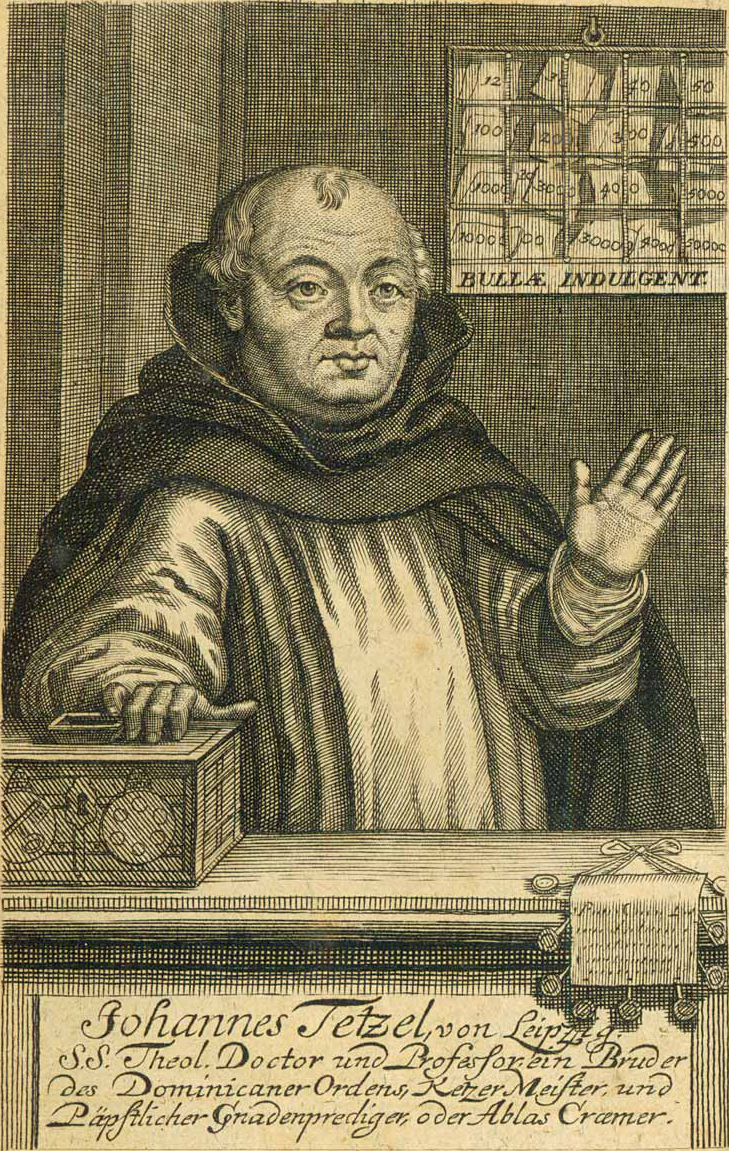
Dominican friar Johann Tetzel (d. 1519) earned notoriety for his aggressive marketing of indulgences in Leipzig, Germany. Source: Wikimedia
There’re other historical examples of practices similar to the selling of Catholic indulgences. In ancient Greece, wandering priests travelled from town to town selling ‘golden passports to Paradise’—similar to the practices of the “Orpheus initiators” criticized by Plato in the Republic (364b-364c):
“begging priests and soothsayers go to rich men’s doors and make them believe that they by means of sacrifices and incantations have accumulated a treasure of power from the gods that can expiate and cure with pleasurable festivals any misdeed of a man or his ancestors”
Now, if each religious community issued indulgence-like certificates, it would be fairly easy to create an ETS as explained above. The promised spiritual rewards need not be grandiose, such as a guaranteed eternal life in Paradise. Each religious community may produce certificates that are consistent with their creeds and theology. They could be no more than attestations of contributions with supplications of blessings for the donor.
3.3. Customizing the ETS:
Just like there’re all types of ETFs in the stock market, ETS’s could be customized in order to appeal to all types of consumer preferences and needs. There can be, for example, an ETS for Abrahamic faiths only, another for Dharmic religions, and yet another for animist religions. Some customers might be certain that salvation is only possible through Jesus Christ, but they’re not sure which church has the correct theology, so an ETS that exclusively ‘invests’ in Christian denominations would certainly appeal to them. Additionally, just like there’re ETFs that replicate ‘socially responsible’ indices (SRI), which exclude companies that operate in controversial sectors (such as weapons and gambling) or follow unethical practices (such as child labor), there could be ‘SRI’ salvation indices that exclude religious organizations that fund, say, holy wars or promote the selling of land in occupied territory.
Of course, there’re many questions that should be addressed when creating ETS’s. For example, what happens if you trade (re-sell) your shares: do you relinquish the spiritual rewards promised by them? Another question is whether the price of a share in an ETS would change over time. Let’s say that there are signs of the end of times, would the prices shoot up as people are scrambling to secure salvation?
Another crucial question for an ETS would be: are you giving money to a religion/denomination per se or to a religious organization? In the same religious community, no matter how small, there can be multiple organizations, so which one to choose? This can lead to competition, with each organization promising more lucrative rewards to attract consumers.
3.4. Are they ‘kosher’? Maybe not, but they could still find buyers!
The most important question is, of course, whether such donations would guarantee you the eternal rewards that each of these religions promise without believing exclusively in its tenets and becoming an active member. Well, this is a theological question, the answer of which would depend on each religion (or each theologian). But even if most theologians would condemn such an idea outright, some people may reason that they have little to lose: putting a ‘small’ amount of money in an ETS, if it brings you salvation: great; if not, you wouldn’t end up in a worse position than your original one. Going to Hell minus few thousand dollars is no worse than going to Hell with that money still sitting in your worldly bank account.
Apart from the theological validity of ETS’s, if an entity does create such a product, it might still be able to sell it with good marketing. They may have some faith-influencers promoting them, like many financial products (some of which are credible, others are dubious) that are pushed to consumers by the so-called ‘finfluencers’. Religious organizations and theologians may even be tempted by the prospects of receiving a steady stream of donations to issue ‘fatwas’ justifying such practices. Historically, there hasn’t been a dearth of clergymen and women willing to give the required opinion, if they were given good carrots or, alternatively, threatened with heavy sticks.
If a former used car dealer reportedly made $12 million selling plots of land on the moon, why wouldn’t another one be able to make even more money selling shares in an ETS or, shall I say, plots of land in Heaven?

AI generated image of real estate agent selling plots of land in Heaven


