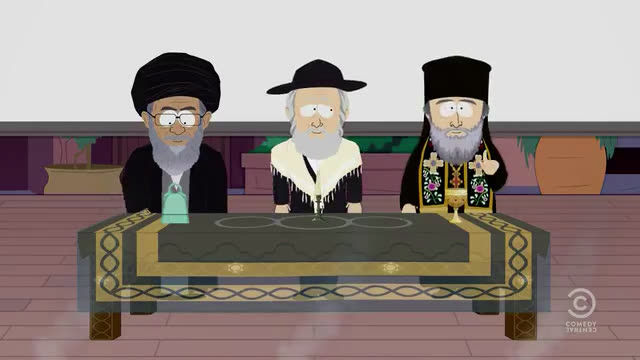
What do Israel, Pakistan, and South Park have in common? Each has transformed a monotheistic religion into an ethnonationalist political identity that has little to do with that religion beyond its name. In this blog post, I will explore these three cases, pointing out the similarities (and few differences) between them. In the last section, I will discuss two possible counter responses to religion as ethnonationalism: one that I call the “Randy-ChatGPT principle” and another one that I would have called the “Jesus response” (I will explain later why I have crossed it out!).
1. Jesus is “All Christian Now”
Let us start with the fun case—the one that has caused no wars, no genocides, and no suffering, except perhaps for busting a gut laughing. In Season 19, premiered in 2015 at the height of wokeness in American culture, South Park introduced a new character named “PC Principal” who became the new head of the primary school in the fictional town of South Park. The “PC” in “PC Principal” stood for “Politically Correct”, and he (a muscular, white “bro”) lived up to his name. He aggressively enforced wokeness in the school, beating the shit out of any kid for the slightest political incorrectness in speech, like using the wrong pronoun or a slightly offensive word.
However, by the time when the most recent season of the show (season 27-28) was made, Trump had returned to office and wokeness had been abandoned by large sectors of mainstream American politics and media. Accordingly, the “PC” in “PC Principal” was changed from “Politically Correct” to “Power Christian”. The previously aggressive, zealous, white woke bro becomes now an aggressive, zealous, white Christian-nationalist bro. As a statement of his commitment to Christianity, PC Principal brings Jesus (a recurring character in South Park) to the school as the new counselor (replacing Mr. Mackey). Initially, we see Jesus hanging out in the school with the halo of sacredness surrounding him, but effectively doing nothing to influence how the school is run.

Later on, in episode “Twisted Christian”, Jesus becomes uncomfortable with the cruel, intolerant, ethnonationalist Christianity that PC Principal is pushing on everyone in the school. So he goes to his office and asks him what branch of Christianity he belongs to, to which PC Principal replies “the kind that loves its country and doesn’t tolerate any fucking fags!”. This is a clever allusion to the fact that when a religion is transformed into an ethnonationalist identity, theological differences don’t matter anymore. MAGA Christianity is neither Catholic nor Protestant. It’s little more than a rallying flag for conservative cultural politics in the United States around issues such as white supremacy, xenophobia, and machismo. When Jesus tells him that the most important thing (about Christianity) is “loving and respecting each other”, PC Principal dismisses Christian morality, insisting that “drastic times call for drastic measures”.
Eventually, when Jesus accuses PC Principal of having “a very warped sense of what Christianity is” and of “using the Bible” to bully people, PC Principal becomes furious and beats Jesus up, accusing him of being “fag”. Jesus eventually submits to PC Principal, accepting the girlfriend he was forcing on him—a woman with exaggerated breast implants and lip injections, wearing a huge cross as a necklace—and becomes a MAGA Christian. The irony of Jesus Christ, of all people, converting to Christianity was aptly satirized in the final episode of the season, when Stan (one of the four protagonists of the show) answers the question “what the hell happened to Jesus?” by saying “he is all Christian now”.

2. A Land without a State for a State without a Land
In 2013, Oxford scholar Faisal Devji published a book about Pakistan as a political idea with the catchy title Muslim Zion. In the first chapter of the book, Devji draws compelling parallels between Pakistan and Israel as the two prime examples of a peculiar form of nationalism whereby membership in the nation is divorced from territoriality. Founded in 1947 and 1948 respectively, Pakistan and Israel defined themselves solely on the basis of religion: the former as an Islamic republic and the latter as its Jewish counterpart. In both cases, first, the nation was defined (through religion); and then, the territory on which to establish the state was chosen largely based on practical considerations (what Devji calls “administrative convenience”).
Let us take Zionism first. Many think of it as a movement whose goal was to establish a Jewish state in Palestine, but this was only partially true. Initially, the founders of Zionism sought the establishment of a Jewish state somewhere. Before they settled for (and settled in) Palestine, they had considered various options such as Argentina and Uganda. Palestine only became a viable option after it had been occupied by the British in WWI, who together with the French thwarted the nascent independent Arab Kingdom in Syria, which at the time included Palestine. Thus for Zionists and their British colonial patrons, Palestine was a land without a state for a state without a land. Even after it was established, the Zionist state in Palestine, tellingly, did not define its borders (so much for a state whose existence was supposedly threatened!), allowing itself to expand continuously by colonizing further Arab territories.
Similarly, Pakistan was conceived as a political entity for Muslims in British India without being attached to any specific part of it on the basis of, say, regional majority or historical roots. As Devji points out, Muhammad Ali Jinnah, the leader of the movement that founded Pakistan, demanded a state for Muslims regardless which shape it would take. For Jinnah, the Muslims of India were a people (nation) without a state, and so they needed a land somewhere in the Indian subcontinent to have their own state on it. Eventually, the partition of India had resulted in the odd situation of Pakistan consisting of two territories that are more than 1,000 miles apart, before the eastern part broke away in 1971 forming the modern country of Bangladesh.
One might point that there is a difference between Zionism and the Pakistan movement in terms of non-territoriality. The latter movement was limited to the boundaries of British India in its aspirations for a territory, whereas Zionism in its early stages sought its territory globally: in South America, Africa, and Asia. This, nevertheless, doesn’t make the Pakistan movement less non-territorial than its Zionist counterpart. A point moving within a small space is not less “moving” than a point moving in a larger one. Both are equally “in motion”. To be clear, I don’t claim that Pakistan and Israel are two identical cases of religious nationalisms. The similarities, however, are far than most people think.
Some people would surely object on ideological grounds to the comparison between Pakistan and Israel—from both countries, but perhaps more from the Pakistani side. Yet leaders of the Pakistan movement did not shy away from pointing to or following the steps of the Zionist movement while promoting their cause. As late as 1981, President Muhammad Zia-ul-Haq—a champion of the Islamization of Pakistani society and politics—told The Economist:
Pakistan is, like Israel, an ideological state. Take out the Judaism from Israel and it will fall like a house of cards. Take Islam out of Pakistan and make it a secular state; it would collapse.
Quoted in Devji, Muslim Zion, p. 4.
A language without a people for a people without a language
Nationalism, of course, is not based on territory alone. Nations are imagined communities, and they are imagined to have a common culture. Yet both Zionism and the Islamic nationalism of Pakistan had little place in their imagination—before the establishment of their respective states—for a shared culture. Take the issue of language, for example, which is typically the cornerstone of any national culture. Much like territory, language was an after-thought for both Zionism and the Pakistan movement. Before Hebrew prevailed—a language that had largely been restricted to Jewish religious circles before Jewish migration to Palestine— German and Yeddish were considered as official languages for the future Jewish state. Likewise, the language debate in Pakistan was not resolved in favor of Urdu until a very late stage; in fact, only after independence. Ironically, Urdu was not native to territories that became Pakistan and was not spoken by more than 3% of the population at the time of independence.
3. A State or a Nation-State Religion?
As we have seen, the typical components of a nationalist movement (such as territory and language, and culture) were absent from Pakistani nationalism and Zionism upon their development. This leaves religion as the only foundation of the national community. Yet were these two movements unique in their incorporation of religion as a nationalist identity? Isn’t religion an essential component of many national identities such as Irish, Turkish, and Greek nationalisms to mention a few? Don’t the constitutions of many countries prescribe an “official religion” of the state?
Devji maintains that the crucial difference in the case of Zionism and Pakistani nationalism is that religion was the only definition of the nation as opposed to being an additional criterion to territory or culture. Catholicism, for example, did not replace territory (the Irish island) or Gaelic heritage as the defining characteristics of the Irish nation. In fact, many early Irish nationalists were Protestant and the Republic of Ireland had Protestant presidents. An “Irish Protestant” is perhaps not so much of an oxymoron as an “Israeli Muslim” or a “Pakistani Hindu”. Similarly in Egypt, a Coptic Christian is no less Egyptian (i.e. member of the Egyptian nation) than a Muslim one, even though Islam is the state religion and the main source of legislation according to the constitution of the country. In fact, the Egyptian constitution speaks explicitly of Jewish and Christian Egyptians (article 3) and of Egypt as having a Muslim as well as a Coptic heritage (article 50).
In Israel, on the other hand, Judaism is the religion of the nation—not the religion of the state. Judaism is basically the same as nationality, since any Jewish person in the world can “return” to Israel and acquire Israeli citizenship. Religion, thus, is an alternative to geography, not its supplement (to borrow Devji’s vocabulary). You might be a citizen of the state of Israel (like Palestinians inside the Green Line) but you can never be a member of the nation whose state is Israel, unless you are Jewish. This was perhaps implicit when Israel was founded, until it was explicitly confirmed through the so-called Nationality Law of 2018, whereby “Israel is the nation-state of the Jewish people” and “the right of national self-determination in the State of Israel is unique to the Jewish people” (i.e. Palestinians, whether citizens of Israel or not, don’t enjoy such a right).
Israel might be a unique case among world countries in linking a specific religion to its national identity. Apart from theocracies or semi-theocracies such as Iran and Saudi Arabia, the closest example I could find is Armenia, whose constitution recognizes “the exclusive mission of the Armenian Apostolic Holy Church in the spiritual life of the Armenian nation”. However, clearly it doesn’t come close to equating membership in the Armenian nation with membership in the Armenian Apostolic Church. Historically, the first constitution of Mexico stated in article 3 that “the religion of the Mexican nation is and will be Roman Catholicism”, but it was in force only from 1824 until 1835.
4. Insufficiently Imagined Communities
Nation-states are imagined communities—they are first imagined, before they become a reality through political mobilization and nation-state building. Israel and Pakistan are no exceptions. Israel was first imagined in a novel by Theodor Herzl, The Old New Land(1902), whereas the idea of Pakistan was first articulated in a pamphlet by Chaudhry Rahmet Ali in 1933. Some nation-states, however, were imagined more than others. In his novel Shame, Salman Rushdie describes Pakistan as “insufficiently imagined” in a passage that may have very well been written about Israel. Each country was conceived as a political abstraction of a religious community, as Devji repeatedly states in his book, without being attached to a specific territory, language, or culture. Even when it comes to religion itself, it was abstracted from faith, lived tradition, or way of life and transformed into a hollow political identity, a flag to rally the masses around, without imagining any substantive content to fill it.
Understandably, during the struggle for the establishment of the state, religion was defined in the least substantive terms in order to rally as many people as possible for the nationalist cause without entering theological debates about who was a Muslim/Jew and who wasn’t. For Zionists, the only criterion to be member of their promised nation-state was being a Jew, with Jew defined purely in racial terms as opposed to religion, which was how Judaism was (mostly) defined well until the 19th C—by its traditional religious leadership as well as by intellectuals of the Jewish Enlightenment (Haskalah) and by followers of the other two monotheistic religions: Christianity and Islam. This was, according to another Oxford scholar Yaacov Yadgar, an influence of Antisemitic racial theories prevalent in Europe during the 19th C, which characterized Jews as a distinct “Semitic race” from the European “Aryan race” (Israel’s Jewish Identity Crisis, p. 10-11).
For the Pakistan movement, on the other hand, Islam was not defined explicitly in racial terms but as a legal-communal category. This allowed the Pakistan movement to present Islam an abstract political identity that stood alone without reference to any specific denomination, creed, practice, or cultural form. Consequently, Muslims from Ahmadis, through Ismaili and Twelver Shi’is, up to Sunnis supported and participated in the Pakistan movement. The transformation of Islam, and Hinduism for that matter, into a legal-communal identity rendered it effectively equivalent to ethnicity, i.e. it is determined by birth more than anything else.
However, after Pakistan and Israel were established, nationalist leaders had to decide as who counted as member of the nation and who did not. This was not simply a matter of intellectual or ideological debate but, more importantly, a significant step in determining a range of legal issues such as acquiring citizenship, religious conversion, and minority rights. These debates, it seems, resulted in the definition of religion going in the opposite direction compared with the pre-independence period: from inclusive, abstract, and hollow to exclusive, substantive, and narrow. Traditionalists and fundamentalists had the upper-hand in deciding the internal, demographic boundaries of the nation after secular-nationalist leaders created its territorial boundaries.
In Israel, there has been a continuous shift to the religious right since 1980’s, with religious Zionism now becoming the dominant political force in the country. According to Yadgar, because Israeli leaders did not put any substantive definition of Judaism except for race, they had to contract the Orthodox-rabbinical establishment to resolve legal disputes in the area of family law (p. 27). As a result, the self-definition of the Israeli/Jewish nation has shifted constantly and gradually to the right.
A similar process unfolded in Pakistan but perhaps more rapidly. Shortly after the death of Jinnah in 1948, who proclaimed upon independence that religion was a personal matter, Islam was gradually placed at the center of the state’s constitutional and legal framework. The country’s first constitution, passed in 1956, declared Pakistan an Islamic Republic, transforming it thereby from an (implicitly) secular state for Muslims to a state with a clear religious identity. The current consitution, adopted in 1973, significantly expanded the role of Islam in politics and law. In 1974, an amendment was added, whereby the state took upon itself the unusual task of prohibiting certain Muslims (Ahmadis) from calling themselves as such. General Zia-ul-Haq solidified Pakistan’s Islamization by implementing measures such as the establishment of the Federal Sharia Court and his involvement with the United States and Saudi Arabia in supporting the Afghan mujahideen. through the Afghan Jihad. More recently, sectarian violence between Sunnis and the Shi’i minority further diminished the inclusiveness of Islam in Pakistani society.
5. How to Negate Negation?
With the benefit of hindsight, we could see how turning religion, whether Islam or Judaism, into an empty signifier may have been a bad idea. So how do we respond? How do we negate something that is a negation of itself? There are two types of responses. One is provided by Randy Marsh from South Park (with help from ChatGPT), so let us call it the Randy-ChatGPT principle. When his son Stan tells him (S27E01) that Jesus was in their school, Randy responded annoyedly, “I don’t think Jesus is allowed to be in school”. Then, he turns to ChatGPT for advice, and “she” (as Randy refers to ChatGPT) told him that public schools have to maintain a separation of state and church and can only teach about religion in a neutral manner. “Yeah, that’s what I thought. The government can’t force a religion on my son!”, Randy replied, happy that ChatGPT has buttered him up and confirmed his viewpoint, as “she” usually does.
By generalizing this principle from schools to the the state, the state of any country can’t force a religion on its citizens nor declare one religion as the religion of the nation/state— however you define the religion in question: as an ethnicity, communal identity, faith, praxis, or way of life. Zionism and Islamic nationalism of Pakistan were not secular ideologies in the first place, regardless whether they have claimed to be so or not. The solution, hence, is a consistent secularism that removes religion not only from the laws of the state and its institutions (e.g. public schools) but also from any explicit or implicit criterion for membership in the national body.
The other possible response to religion as a political identity—be it Zionism, the “Muslim Zion”-ism of Pakistan, or MAGA Christianity— is to bring back the religious content that has been emptied out. Had Jesus not converted to MAGA Christianity in the final episodes of the most recent season of South Park, we could have called it the “Jesus solution”. This solution entails going back to religious traditions to refute ethnonationalism proclaimed in the name of that religion; that is, to use traditions against traditionalism, Christ against Christian nationalism, Islam against Islamism—to remove the (ideological) -ism from the religion, because, in the wise words of rapper Ras Kass, “every -ism is a schism”:
Going back to traditions does not mean setting the clock back to pre-modernity but to resurrect these traditions and interpret them in accordance with the age: an age of tolerance and pluralism instead of an age of nationalism and ideology. To illustrate this response, I’m going to use an example from Jewish Currents—an American Jewish publication in the Bund tradition (the Jewish socialist movement in Eastern Europe in the first half of the 20th C, which has far better claim to self-consistent secularism than its Zionist rival). In a persuasive response to an article that had been published in the summer 2025 issue of Jewish Currents, a reader of the magazine wrote:
In his recent piece, Jon Danforth-Appell writes that “the Jewish left as a whole has yet to articulate a project that is not just the negation of Zionism.” But in searching for the positive content of anti-Zionist Judaism, might we consider… Judaism? Our traditions of dialectic argumentation and empathy for the vulnerable, to give just two examples, ought to be rich enough to furnish the positive content we seek.
Isaac Congedo
Silver Spring, MD
Jewish Currents, Fall 2025, “Letters from Our Readers”, p. 5 [emphasis added]
See Summer 2025 issue, p. 80, for the original essay the reader responded to, “Against Zionist Realism”. Another article in the same issue, “We Need New Jewish Institutions” by Arielle Angel, is also relevant for this debate.
As the reader, Mr. Congedo, eloquently puts it, if Zionism was the negation of Judaism then Judaism could be the negation of Zionism. Surely, as Zionism has become hegemonic in most Jewish communities around the globe, it’s a steep hill battle for Non-Zionist Jews (anti-Zionists or just plainly indifferent to Israel, like Sheila Broflovski) to create new Jewish interpretations, institutions, and communities that refill the void left out by Zionism. Yet the change is happening, at least in the United States (home to the largest Jewish population in the world after Israel), as some recent surveys have shown.
I wish I could make some observations about current debates within Pakistan and any currents that are attempting to transcend its Islamic nationalism into one that is more inclusive, but unfortunately I am not adequately informed in this regard.
6. Conclusion: Separatism Sucks Ass!
Since I started this post with South Park, I feel obliged to conclude it with another reference to the show, even though it might be less perfect in illustrating the point I want to make. In Season 3, episode 9, Kyle—the Jewish kid in South Park—wanted to take his friend Kenny—who is not Jewish— with him to “Jewbilee” (a scouts camp exclusively for Jewish kids). When the identity of Kenny is exposed, he is banished by Jewish elders outside the camp. Yet as the elder of the “synagogue of Antisemites” was about to release the evil spirit of Haman, Kenny sacrifices himself to save Jews in the camp. Consequently, as Kyle delivers the running “I learned something today…” line of early seasons of the show, he says:
it’s fine to have your own beliefs and your own traditions, but as soon as you start excluding people from your ways only because of their race, you become a separatist and being a separatist sucks ass!
I realize that Kyle here is talking about excluding people who are not racially Jews from Judaism as a religion, not about excluding non-Jews from the state of Israel. But I think the logic is the same, and if Kyle were to speak about Israel’s Nationality Law or about its occupation of Palestinian territories without granting Palestinians equal citizenship with Jews, I’m convinced that he’d say something like:
it’s fine to have your own nation and your own country, but as soon as you start excluding people from your state only because of their race, you become a separatist and being a separatist sucks ass!
[underlined words were changed from the original]
 Religion, Culture, Society